
Knowledge of the Increasing Demand of Intelligent Plantation Lighting.
Plantations of oil palm work in harsh, remote and demanding environments. Lighting in these areas should work reliably and shouldn’t need human help often.
Conventional street lighting solar lights struggle in palm oil areas. They face dust, pollen, oil, humidity, and insects. The efficiency of panel is not sustained and maintenance becomes expensive and unreliable.
It is with this that self cleaning street light palm oil solutions can be seen as a viable and sustainable improvement. They handle actual issues in the plantation as they concur with long-term operational efficiency.
The Question of a Self-Cleaning Street Light? (And Why It Matters)
Definition and Core Concept
A self-cleaning street light is a solar-powered light. It has an automated system that cleans dust, debris, and residue from the solar panel’s surface.
The idea is easy: maintain the panel clean to ensure that the energy uptake is high all the year round. This contributes towards making the system suitable to agricultural and palm oil plantations.
Technology is used in the direct improvement of reliability and minimization of manual labor in the context of self cleaning street light palm oil projects.
How the Self-Cleaning Mechanism Works: Technical Overview.
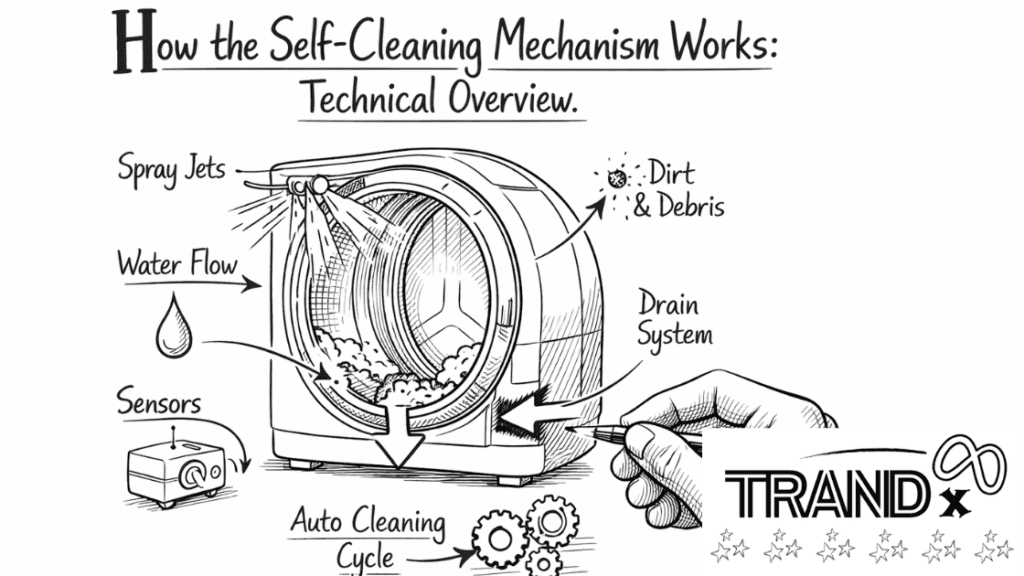
The majority of the systems employ mechanical brushes, cleaning by air, hydrophobic covering, or a combination of both.
You can set the cleaning cycles to start daily, weekly, or when dust levels hit certain points. The systems have low power usage.
The outcome is homogenous light without the need to make frequent services.
Palm Oil Regions are great for Self-cleaning Street Lights because
Environmental and Operations Issues in Palm Oil Areas.
- Palm oil plantation is known to have special problems: airborne fibers, oil mist, high humidity, high rainfall and biological debris.
- The conditions enhance the contamination of the panels. Traditional solar lights become inefficient within a short time, in some cases, weeks.
- This is what renders self cleaning street light palm oil installations not as a luxury but as a necessity.
- Self- Cleaning Lights as the Solution: Major Benefits.
- Self-cleaning lights keep electricity levels steady. They save on cleaning costs and extend the life of the panels.
- They enhance security of workers, vehicles and night shifts in the plantations.
In the long-term, the investment is paid off in the form of decreased downtime and maintenance expenses.
Elements of a Self-Cleaning Solar Street Light.
Solar Panel: Coating, Quality and Build.
Mono or polycrystalline panels of high efficiency are preferred. Performance is enhanced by anti-soiling or hydrophobic coating.
Coating quality is crucial in self-cleaning street light palm oil systems. This is due to exposure to oil residue.
they must be durable and UV resistant.
Cleaning Specification: Brush vs Coating vs Hybrid.
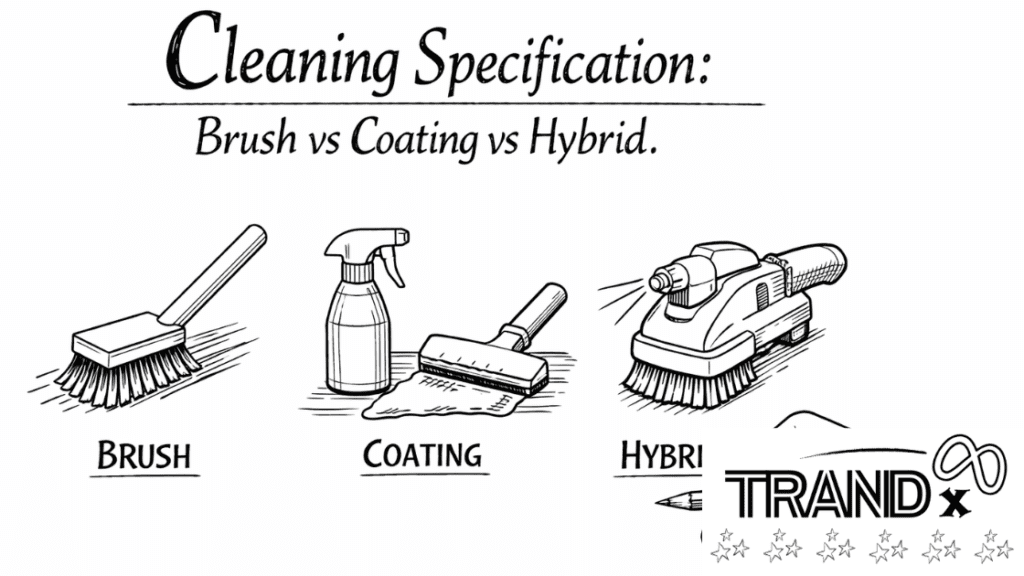
Brush systems are done manually, and debris is removed physically. The systems based on coating decrease adhesion. Hybrid systems combine both.
Hybrid designs are often the best in palm oil areas. This is due to their ability to handle different types of contamination.
The cleaning system should be in line with environmental realities.
Power Storage and Power Control Systems.
Modern systems are dominated by lithium batteries that have been characterized by high life and a constant performance.
Smart controllers control the amount of energy consumed, cleaning, and lighting cycles.
This makes sure that it works even when there is a cloud.
Lighting and Structural Build, LED.
The LED modules with high lumens offer even lighting and low energy consumption.
The electronics of the humid environment of the plantation are safeguarded by corrosion-resistant poles and IP66-rated enclosures.
Operating Principle: How Self-Cleaning Solar Street lights Work Everyday.
The solar panel recharges the battery during the day and remains clean using automatic cleaning systems.
LED lighting uses the stored energy in a more efficient way at night. Sensors control the brightness depending on the motion or ambient lighting.
This self cleaning cycle of palm oil solutions makes the use of self cleaning street light solutions the best one in remote plantation regions.
The Palm Oil Industry Why Palm Oil Industry Should Clean Solar Street Lights.
Plantations are run on large spaces where the grid connectivity is weak.
Hand washing is more costly in labour and is more unsafe.
Self-cleaning systems minimize the operational friction and maintain a regular lighting throughout the year.
They help in sustainability ambitions and enhancing productivity and safety.
Case Study: Port Harcourt, Nigeria -The Palm Belt Lighting Project.
Solar street lights were installed in the palm belt of Nigeria at its plantation access roads.
Initial installations had a problem of heavy dust and residue. Maintenance teams had problems with keeping panels clean.
With the adoption of self cleaning street light palm oil technology, energy output became stable and the number of visits reduced significantly.
There was a long-term value reflected in the project.
Installation Planning Before Installation
: Before installing the system, there are several considerations and benefits that must be taken into account prior to installation.
Site Evaluation and Study of the Environment.
It is necessary to know about dust concentration, precipitation, and exposure to oil mist.
This helps to select cleaning mechanism and panel coating.
Effective planning guarantees high efficiency of the system.
Installation Planning and Maintenance Planning.
Self-cleaning lights save on periodic maintenance although they still need periodic examination.
The scheduled spares and distance measurement helps increase reliability in the long term.
Cost Considerations and ROI
Initial expenses are more than regular lights but the operation savings compensate this in a short time.
In the case of plantations, the cost efficiency of self cleaning street light palm oil increases after several years.
Change In Scale: Local to Global Sustainability.

Self cleaning lamps contribute towards the reduction of carbon through optimal utilization of sunlight.
It minimizes the reliance of diesel generators and grid extensions.
This is in line with international sustainability and ESG in agriculture.
Developing the Future of Agricultural Infrastructure.
Infrastructure is forced to develop as modernizing palm oil plantations are developed.
A viable solution is self cleaning solar street lights which are scalable.
They integrate energy savings, automation and durability within a system.
Summary: What The Reader Needs to Know.
Self cleaning street lights are not some experimental technology.
They address the actual issues of operation in palm oil regions due to dust, oil residue, and humidity.
A self cleaning street light palm oil offers reliability, low cost and sustainability hence the system is a smart long term investment.
The article ends here. Now, let’s read the FAQs below.
FAQs You May Concern
Why would self cleaning street lighting be superior to regular solar lights in palm oil plantations?
They automatically keep panel efficiency and minimize maintenance requirements and maintain steady lighting in dusty and greasy workplaces.
Are self cleaning solar panels a reality?
Field deployments are much more energy output and the degradation is low in comparison with manually cleaned panels, yes.
What is the frequency of cleaning cycles?
Most systems run on a daily or weekly basis based on the amount of dust and the design of the system.
How much more is self cleaning street light palm oil systems?
They cost more at first, but they’re less exciting over time. They need less maintenance and last longer.