
What is Data Discovery Tools?
Data discovery tools are made to help businesses find, analyse, and visualise their data in a sensible way. These platforms connect to different data sources. They automatically profile and categorise this data to make it useful.
Businesses use these tools in order to identify trends, find concealed patterns and make sound decisions. They also help make it easier to understand a lot of data without needing technical skills.
Data discovery technologies turn raw data into useful insights. This helps teams make better decisions, plan effectively, and keep data compliant across the organisation.
The need of Businesses in Data Discovery Tools.
Any organization produces massive amounts of data on a daily basis. This data may prove to be bulky, disjointed and ineffective with inadequate tools. The gap is addressed using data discovery platforms.
Automation of data collection, classification, and visualization of data allows teams to concentrate on insights, but not data wrangling. These tools also enhance governance, accuracy and facilitation of evidence-based decisions in a short period.
Firms using these tools gain a competitive edge. They can quickly spot trends, predict customer patterns, and improve operations. This is one of the abilities that are necessary in the fast-paced digital world in 2026.
Types of Data Discovery Tools.
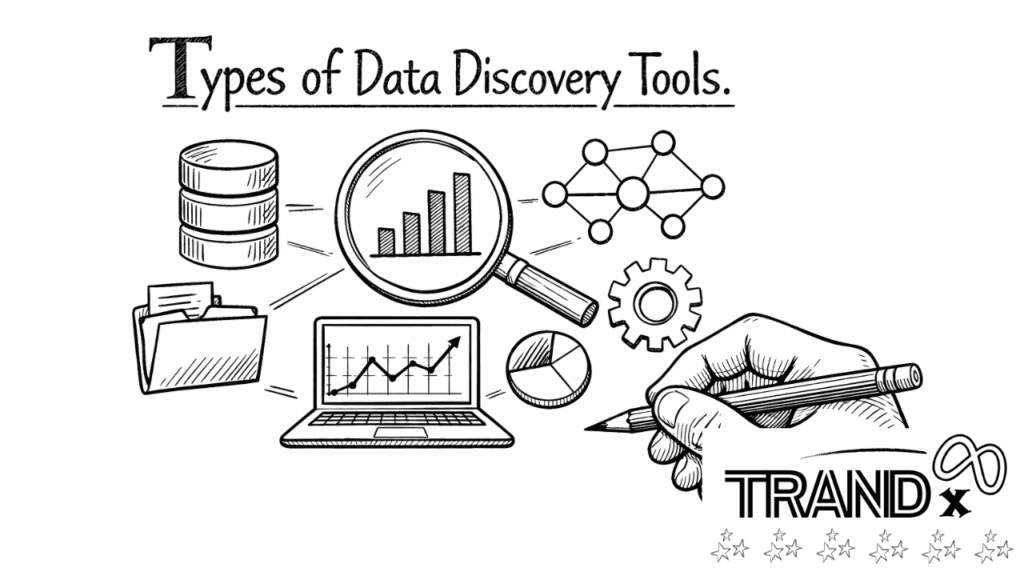
Data discovery tools come in various types, depending on their focus and features. Unstructured data discovery tools scan documents, emails, and other formats. They uncover important insights.
Automated discovery tools use AI and machine learning to analyse data with little manual effort. In contrast, compliance-oriented data discovery tools help find personal or confidential information.
Analytics, governance, and reporting come together in data discovery and classification platforms. This setup provides an enterprise with complete visibility. Both types are dealing with specialized business requirements.
Data Discovery Tools: Major Characteristics to consider.
Source Connectivity: Capability to connect to numerous databases, cloud services, and third-party applications.
Metadata & Data Lineage Visualization: Shows where data comes from, how it moves, and how it changes.
AI-based Classification: It labels data on its own. This helps us gain insights faster and comply better.
Data Profiling and Quality Scoring: Data is correct, complete and analysis ready.
Collaboration Dashboards: Teams can work together in real-time using insights, reports, and visualisations.
Advanced Services: Predictive analytics, anomaly detection, and trend forecasting.
Top 10 Data Discovery Tools in 2026
Looker
Advantages: Complex dashboards, custom reporting and real-time analytics.
Pricing: Subscription, which can be scaled between small and large businesses.
Qlik Sense
Advantages: Interactive visualization, associative data model and AI-driven insights.
Pricing: Tiered pricing depending on the number of users and features.
Domo
Pros: Mobile-first dashboards and collaboration features of business intelligence.
Tableau
Advantages: Easy to use visualization, powerful analytics community, powerful integrations.
Pricing: Individuals, teams, and organization flexible plans.
SAP Analytics Cloud
Advantages Enterprise analytics, predictive insights and good integration with SAP products.
Pricing: Subscription based model that has various modules.
IBM Cognos Analytics
AI-assisted reporting, data exploration, and governance solutions.
Pricing: Enterprise subscription and scales.
Microsoft Power BI
Advantages: Intense dashboards, solid integration with Microsoft, real-time updates of data.
Pricing: Free plan; Pro and Premium plans when increasing the team size.
Atlan
Benefits: Data catalog, teamwork, and governance features.
Alation
Benefits: Data listing, query performance understanding and collaborative tools.
Collibra
Perks: Enterprise data governance, lineage visualization and compliance tracking.
The selection of appropriate data discovery tool.
Establish Objectives: Learn business needs, what kind of insights are needed.
Map Data Landscape: Find out the location and flow of your data.
Must-Haves vs Nice-to-Haves: Focus on features that ensure compliance, governance, and insights.
Test in Real World: Test the tool on your data to assess it correctly.
Test Scalability & Support: Make sure that the tool will be able to expand with your organization and provide a stable support.
Advantages of Data Discovery Tools.
Ideate Actionable Insights: Make decisions rapidly.
Reduce Manual Data Processing, Reduce Manual Data Analysis.
Scale Between Departments: Divulge knowledge effectively between departments.
Clean & Reuse Data: Be accurate and reuse data to use in a number of ways.
FAQs on Data Discovery Tools
What is a data discovery tool?
A platform that collects data, analyses and visualizes it to give actionable insights.
What are the working principles of the data discovery tools?
They are linked to data sources, profile, classify and visualize data to make decisions.
What are the reasons why the businesses require the data discovery tools?
To enhance precision, management, adherence and get quicker insights.
What are the characteristics that I would consider in data discovery tools?
Connection, artificial intelligence classification, collaboration, visualization, and analytics was available.
What are the benefits of these tools in compliance?
Governance modules and finding sensitive data help meet GDPR, CCPA, and other rules.
Conclusion
Data discovery tools are now a must-have for businesses. They help turn large amounts of data into real benefits. Choosing the right tool helps organizations improve decision-making, ensure compliance, and boost growth.
The right platform can uncover insights. It helps teams collaborate, spot trends, and expand analytics across the enterprise efficiently. Making a good decision will mean maximizing the data value and minimizing the risk.