
Introduction to Transport Block Size.
A key idea in modern wireless networks is transport block size (TBS). It determines the size of the information that can be conveyed within a transport block.
Reliable communication and efficiency of the network are guaranteed by accurate computing of TBS. TBS is important with regard to high-speed data transfer with 5G.
TBS relies on various factors such as modulation schemes, coding rates and network conditions.
TBS has to be planned carefully by an engineer in order to achieve maximum throughput and at the same time ensure signal quality.
Misconfigurations may result in poor performance, lost packets and poor use of spectrum.
Current systems like 5G NR use flexible TBS settings. This helps them manage changes in traffic and network conditions.
With this flexibility, it is possible to serve high-density areas better and provide a better user experience.
It is quite important to be familiar with the concepts of TBS when carrying out network design.
What is a Transport Block?
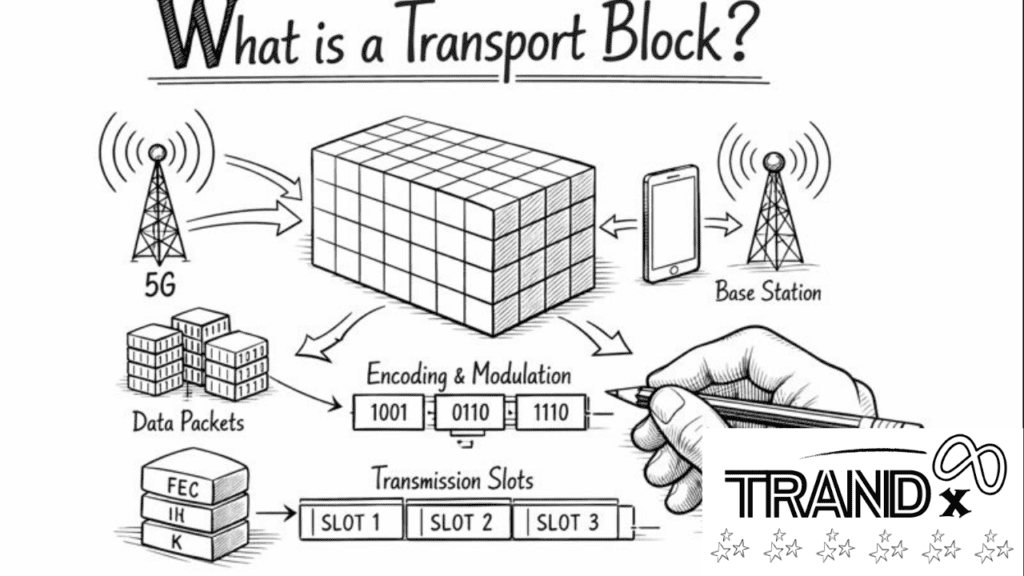
A transport block is a block of information relayed on air interface of mobile networks.
It has coded user data, which is to be transmitted using the physical layer.
Channel coding and error-checking of transport blocks are performed to verify the data integrity.
The transport block size depends on the channel conditions, bandwidth and modulation among other factors.
In the case of higher-order modulation, it means that large TBS may be used, which enables higher data rates.
On the other hand, when network conditions are poor, smaller TBS can be used to be reliable.
In LTE and 5G networks, transport blocks are key to scheduling decisions.
TBS is allocated dynamically to various users by schedulers and offers maximum speed and reliability.
This dynamic task enhances the spectrum efficiency and the performance of the network on the whole.
Significance in Contemporaneous Networks.
Proper TBS calculation affects throughput, latency and quality of the service.
TBS has a direct influence on increased mobile broadband and ultra-reliable low-latency communication in 5G networks.
Big transport blocks are less expensive and allow them to transport more data but demand improved signal quality.
Network operators use TBS patterns to debug performance problems.
They are capable of modulating depending on the insight of TBS, coding, or allocating resources.
Considering a case in point, the dense urban networks usually require smaller and adaptive TBS that are more stable.
Effective TBS is designed to guarantee the users achieve quick downloads, improved streaming and reduces the latency.
It also can be used with such advanced applications as VR, autonomous driving, and cloud gaming.
TBS is not only a technical measure, but an enabler of user experience.
transport block size operation How it works.
The Role of Encoding
Encoding converts unstructured user data into a format that is transmitable.
Such error-correcting codes as LDPC or Turbo Codes are used to avert transmission errors.
The code used affects TBS where redundancy enhances the reliability but lowers the effective data rate.
To maximize the throughput, network engineers trade-off TBS size and error protection.
Higher TBS that has high error correction can process poor channels without retransmissions.
This is a balance that is necessary in high-speed 5G applications.
Network Conditions Networks: Influence of Network Conditions.
TBS is influenced by network factors such as signal-to-noise ratio, interference and bandwidth.
In an example, a weak signal involves transportation blocks that are smaller so as to promote reliability.
Dynamic TBS control enables the network to react to changing conditions dynamically.
Schedulers keep on computing optimal TBS of each user depending on the prevailing conditions.
Through this method, there is less retransmission and enhanced spectral efficiency.
Essentially, TBS is a tool that is adaptable and reacts to the real world network environment.
Influencing factors of the Transport Block Size.
Bandwidth and Latency
Bigger bands increase the size of the transport blocks enabling greater data transmission.
Nevertheless, application with a high sensitivity to latency might need smaller TBS to deliver in-time services.
In 5G networks, it is important to balance bandwidth and latency.
Protocols and Standards of networks.
TBS is characterized based on such standards as 3GPP LTE and 5G NR.
The best block size is determined through the use of modulation and coding schemes (MCS).
Standards guarantee devices and networking vendors interoperability.
Hardware and Resource Containment.
Maximum TBS is also limited by memory and processing power.
Base stations are required to size hardware to prevent peak traffic congestion.
Effective planning leads to uniform performance and elimination of bottlenecks.
Experimental Implementations of Transport Block Size.
Real-World Examples
Mobile phones downloading at a high speed are based on the large transport blocks.
Video streaming media enjoys streamlined TBS to play without any hustle.
To be more energy efficient and reliable, IoT devices can have smaller TBS.
Daily Communication Benefits.
Optimized TBS will improve the quality of calls, decrease drop connections, and improve web browsing.
Applications, such as cloud gaming, and video conferencing, are dependent on stable TBS to provide a smooth experience.
Misconfigurations of TBS, even minor ones, can have a significant impact on the user satisfaction.
The future of the Block size of transport.
Innovations on the Horizon
TBS optimization based on AI could be used in future generations.
Adaptive algorithms would be capable of forecasting the best block sizes depending on the traffic trends and user behavior.
This will enhance efficiency and congestion in the network will be reduced.
Opportunities and Challenges.
The control of 5G TBS at high density is still problematic.
Network operators need to deal with different conditions, devices, and latency needs.
Nevertheless, state-of-the-art TBS management provides the possibilities of improved user experience and capacity.
Summary
One of the basic concepts of the modern mobile networks is transport block size.
It affects throughput, reliability and user experience of both LTE and 5G systems.
Network engineers can make sure that the performance is high by learning TBS and using adequate planning.
TBS plays a central role in the efficient and responsive wireless communication, between encoding and dynamic adaptation.
FAQs
So what is the purpose of TBS?
TBS determines the size of the data to be transferred per transmission and this guarantees reliability and efficient utilization of the network.
Does TBS have an impact on mobile speeds?
Yes, with bigger transport blocks there is more throughput, which means an increase in download and upload speeds.
How is TBS calculated in 5G?
Modulation, coding rates, bandwidth and existing network conditions are used to determine TBS.
Can TBS change dynamically?
Yes, networks also change TBS dynamically to maximize performance and reliability.
What is the significance of TBS to the IoT devices?
Smaller TBS conserve energy and will still ensure data transfer reliability in the case of IoT.
What will happen to TBS when it is excessive?
Large blocks can lead to retransmission when the network conditions are poor and this reduces efficiency.
Is TBS unanimous between LTE and 5G?
No, 5G has finer and adaptive TBS features than LTE.
Can users influence TBS?
It is not directly, it is controlled by the network on the condition and scheduling algorithms.
How does TBS affect latency?
Smaller TBS will be able to minimise transmission delay, enhance performance of real time communication.
What trends does TBS have in future?
AI-driven optimization, dynamic adaptation, and smarter scheduling are shaping the future of TBS.